|
 
|
|
|
|
|
|
NATURAL HOUSEBREAKING
( KENNEL TRAINING ) METHOD
|
|
INTRODUCTION |
|
Welcome to the world of dog ownership! This can be one of
the most satisfying experiences you |
|
will ever know -- unfortunately, it can also be one of the
most trying. The quality of this experience, |
|
and the quality of your relationship to your pet is
directly related to the choices you make concerning |
|
training, housing, diet and discipline. |
|
|
|
Many people regard animals ( except apes, dolphins, etc. )
as unthinking. This couldn't possibly be true; |
|
there would be no such creature as a trained pet. Animals
-- all animals -- make choices; choice making |
|
is thinking. |
|
|
|
As you read this, keep in mind the way we raise our human
infants. As babies, we kept them in high- |
|
sided beds with bars. We pay close attention to their
diet, we supervise them closely at all times, we |
|
potty train them by offering them a choice, and praising
them when they make the correct choice. |
|
The following is an outline for successful housebreaking
that applies the same principles to the |
|
training of your puppy. |
|
|
|
THE CIVILIZED PUPPY |
|
Over the years, a basic truth about domestic dogs has been
forgotten. They were once a handful of |
|
distinct groups living and hunting in packs, and sleeping
and raising their young in dens or caves. |
|
Adult pack members would leave the cave to eat, hunt and
relieve themselves. While puppies (cubs) |
|
would be fed in the den and kept hidden there. Naturally,
very young pups would relieve themselves |
|
in the den, but their wastes were quickly removed by their
mothers or other pack members. As soon |
|
as the pups were able to move about, adult members would
take them outside of the den for exercise |
|
and to relieve themselves. (We can observe these
conditions today with foxes, wolves and coyotes). |
|
|
|
KNOWLEDGE IS POWER |
|
Using the information you have already read and following
a simple step by step procedure shown in the |
|
following paragraphs ANYONE can mold and create their own
civilized puppy. |
|
|
CONS OF PAPER TRAINING |
|
Forget the old idea of partitioning off an area and using
newspaper; this sends your puppy mixed signals. |
|
The idea is that we do not want them to relieve themselves
in the house at all -- the paper method |
|
encourages the opposite. When paper training, you are
giving your puppy permission to use the |
|
bathroom in the house. It also does nothing to prevent
property damage during teething. |
|
|
|
The crate or kennel will become your puppy's den: the
housekeeping and hygiene habits learned in |
|
the crate will be applied to your house. Use a water
bottle as opposed to a bowl to avoid spills. |
|
Spilled water encourages your puppy to relieve itself as
well. Water should be available at |
|
all times. Always take your puppy outside to learn the
area you wish the puppy to use for relief. |
|
Do not let your puppy out unsupervised even if you have a
fenced yard. It is important that you are |
|
there to praise your puppy's performance. Remember that
excited puppies, like children, will get |
|
so involved with playing that they forget to relieve
themselves and then it happens suddenly at the |
|
most inopportune time. Leashes can be used, like Pavlov's
bell, to program your puppy for a certain |
|
response. Remember: take your puppy out on his leash,
praise him profusely ( no food rewards ) |
|
for a job well done, take him back inside and remove his
leash. Then you can allow him some free |
|
play time inside or in the fenced backyard -- but separate
the two activities so that your puppy will |
|
know what is expected of him. HINT: If your puppy does not
want to relieve himself while on the lead, |
|
stand in one spot (preferably one already used by him)
and pivot, walking the puppy around in a circle. |
|
This works wonders !!! |
|
|
|
Use a good quality, heavy non-tip dish so the puppy can
not turn his food over. |
|
|
|
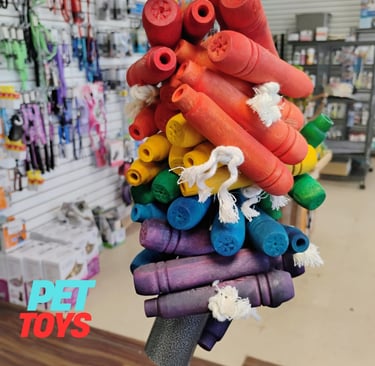
Since your puppy will spend a good deal of time in his
crate he will need appropriately sized toys and |
|
teethers to stimulate him mentally and physically and curb
that awful urge to chew. Ask your |
|
pet consultant to show you these items so that you can
make an educated choice. |
|
|
|
We cannot stress enough the importance of diet as it
relates to your puppy's overall mental and |
|
physical development. Premium quality pet foods, with
their optimum scientific formulation and |
|
reduced or eliminated by-products will help tremendously
because they reduce stool volume and |
|
frequency. They also help maintain your pet's health and
keep your pet out of the vet's office! |
|
|
|
Keep a bottle of good quality stain/odor remover ( such as
Nilodor, Outright or Four Paws enzyme |
|
cleaners ) handy in case of accidents that happen when you
forget to do your part in the day to day |
|
supervision of your puppy. |
|
|
|
Above all, avoid the use of old towels and clothing for
bedding materials for your puppy. If it imprints |
|
in the puppy the idea of sleeping on your scent and
chewing on things that smell like you, it will be |
|
virtually impossible to change his mind. The worse case scenario: he will insist on sleeping on your bed |
|
and furniture and may raid your dirty clothes hamper and
destroy valuable clothing. Do yourself a favor - |
|
get a dog cushion, mat or bed. |
|
|
|
We are now ready to proceed to your daily routine. The
following is a schedule to go by. Insert the |
|
times that suit your lifestyle and the puppy will adjust.
Be rigorous in keeping to the same times for |
|
going out, as the puppy's internal clock is very precise
and the pup cannot wait more than 5 - 10 |
|
minutes past a scheduled time. As it grows older, it will
be able to wait longer if needed. |
|
|
|
DAILY ROUTINE |
|
MORNING |
|
1) Pick the pup up out of the crate or kennel, put him on
a lead, CARRY him outside to a designated |
|
spot and let him walk until he goes -- praise him
profusely. DO NOT let the puppy walk out of his |
|
crate -- he will use the bathroom as soon as he sets foot
outside of his kennel. |
|
|
|
2) Feed him breakfast. Put the food down for 15 minutes
and then remove. This teaches the pup to |
|
stop playing and eat when it's time - thus avoiding the
problem of picky eaters. |
|
|
|
3) Put the pup back in the kennel while you get ready for
work. |
|
|
|
4) Within 15 - 20 minutes of eating, the puppy will need
to relieve itself. Take it outside and walk him |
|
until he goes. DO NOT FORGET TO PRAISE !!! |
|
|
|
5) Put him back in his crate before you leave. Be sure
that the water bottle is accessible to him. |
|
|
|
6) If you can get home at lunch for a quick outing, by all
means do so. However, if you cannot, do |
|
not worry about it -- the puppy will learn to live without
this luxury. |
|
|
|
AFTERNOON |
|
7) Remove pup from kennel and put him on a lead, carry him
outside to a designated spot and walk |
|
him until he relieves himself. Praise him profusely !!! |
|
|
|
8) Puppy can have free play time in or out of the house as
long as he is closely supervised. If, when |
|
playing indoors, the puppy begins circling or squatting --
immediately and firmly say NO and take it |
|
straight outdoors. REPEAT step # 7. |
|
|
|
9) Repeat steps 7 & 8 several times during the
afternoon as time permits. |
|
|
|
EVENING |
|
10) Remove your puppy from his kennel when you get home,
put his lead on and carry him outside |
|
to the designated spot. Let him walk until he relieves
himself. Praise him profusely. |
|
|
|
11) Dinner -- put food down for 15 minutes then remove the
dish. |
|
12) Put the puppy back in the kennel for 30 minutes. |
|
13) Remove the puppy from the kennel, put his lead on and
carry him outside to the designated spot. |
|
Let him walk until he relieves himself. Praise him
profusely. |
|
14) Your puppy can now have free play time in or out of
the house as long as he is closely supervised. |
|
|
|
BEDTIME |
|
15) Carry your puppy outdoors to the designated spot. Let
him walk until he relieves himself. Praise |
|
him profusely. |
|
16) Put your puppy in his kennel for the night. ***A
stuffed animal toy made especially for dogs, |
|
when given to the puppy only at bedtime, works magic at
keeping the puppy from crying or howling.*** |
|
Puppies can choke on plastic eyes or other parts of toys
that are not specifically made for dogs !!! |
|
|
|
Repeat this process daily until you feel satisfied that
the puppy has it down pat ( average 3 -- 14 days |
|
if done properly). As you go, gradually increase the
amount of time the puppy spends out of the kennel. |
|
If the puppy soils the kennel DO NOT punish him. Remember,
it's his kennel and the mess will agitate |
|
him enough to make him wait even longer next time. DO NOT
use the kennel as a punishment -- it |
|
should be a positive place for the puppy. Giving your
puppy a small treat every time he is put in the |
|
kennel can work wonders to make him see it as a positive
place. |
|
|
|
Some puppies will be completely conditioned in as little
as 48 hours, but the average puppy will take |
|
five to fourteen days.
DON'T GIVE UP -- THIS WORKS !!! |
|
|
|
    
|
|
|